Un processus de contrôle qualité non documenté draine activement les marges bénéficiaires de la fabrication en raison de taux de rebut élevés et de rappels de produits coûteux.. S'appuyer sur des contrôles visuels subjectifs à la fin de la chaîne de production permet à des écarts de formage mineurs de dégénérer en défaillances généralisées des conteneurs..
Cette analyse décompose les cadres d'inspection exacts nécessaires pour éliminer les défauts le plus tôt possible.. Nous évaluons les méthodologies statistiques de contrôle des processus, spécifique 10 à 20 N cibles de force de fermeture, et des limites strictes de migration chimique pour vous aider à standardiser la production et à protéger vos résultats..
Pourquoi le contrôle qualité est important dans la fabrication de boîtes en fer blanc

Un contrôle qualité efficace dans la fabrication de l'étain garantit la sécurité des produits et l'intégrité structurelle tout en éliminant les reprises coûteuses et en protégeant la réputation de votre marque..
Protéger l'intégrité des produits et la sécurité des consommateurs
Les boîtes en fer blanc constituent la principale défense pour les produits sensibles. Les équipes qualité appliquent des contrôles de processus rigoureux pour garantir que ces conteneurs fonctionnent de manière fiable sous contrainte physique et exposition environnementale..
- Étanchéité à l'air et résistance chimique: Des contrôles physico-chimiques rigoureux maintiennent le contenu stable et préviennent activement la détérioration ou la contamination..
- Conformité matérielle: Les inspecteurs vérifient la composition du fer blanc et testent les revêtements non toxiques pour garantir le respect des réglementations strictes en matière de contact alimentaire et de sécurité chimique..
- Durabilité structurelle: Les tests de résistance aux chocs et aux boucles confirment que le conteneur résiste aux lignes de remplissage, chocs de transport, et un stockage à long terme sans panne.
- Prévention de la corrosion: Les tests d’intégrité du joint bloquent la pénétration de l’humidité, tandis que les contrôles accélérés de la corrosion empêchent la formation de rouille pour préserver la durée de conservation du produit..
Contrôler les coûts de fabrication et défendre la valeur de la marque
Au-delà de la sécurité fonctionnelle, un cadre de qualité discipliné a un impact direct sur les marges bénéficiaires. L’emballage sert de représentation physique de votre marque, rendre la cohérence visuelle et structurelle essentielle au succès sur le marché.
- Contrôle des coûts: La détection précoce des défauts des matériaux minimise le gaspillage. Cela réduit les déchets, élimine les reprises, et évite les rappels de produits coûteux qui drainent les revenus.
- Excellence esthétique: Les inspections visuelles maintiennent des normes esthétiques élevées en rejetant les rayures de surface, impressions mal alignées, et les premières taches de rouille qui nuisent à la perception du consommateur.
- Préparation à l'audit: Le strict respect des protocoles de qualité permet aux fournisseurs d'obtenir les certifications essentielles de l'industrie et de passer des audits d'acheteurs rigoureux..
- Compétitivité du marché: Cohérent, un emballage sans défaut réduit les retours des clients et les réclamations au titre de la garantie tout en renforçant la fidélité à la marque à long terme.
Points d'inspection clés pour la production de boîtes en fer blanc
Protocoles d'inspection stricts pour tous les matériaux, structure, et l'emballage évitent les pannes catastrophiques, assurer la conformité réglementaire, et protéger la réputation de la marque depuis l'usine jusqu'au rayon de vente au détail.
| Phase d'inspection | Vérifications cibles | Objectif qualité |
|---|---|---|
| Matériel & Structure | Épaisseur, résistance à la rouille, coutures, dimensions | Garantir l’empilabilité et l’intégrité de la base |
| Visuel & Fonctionnel | Imprimer l'inscription, test d'étanchéité, intégrité du revêtement | Valider la cohérence esthétique et la sécurité des produits |
| Emballage final | Codes-barres, nombre de cartons, étiquetage des palettes | Assurer un transit sécurisé et une traçabilité des lots |
Contrôle qualité des matériaux et des structures
La base d'une boîte en fer blanc fiable réside dans ses matières premières et son formage mécanique. Nous commençons par auditer le métal entrant avant tout estampage ou impression.. Une fois le matériau entré dans les lignes de presse, les inspecteurs se concentrent fortement sur la façon dont le métal se comporte sous pression et à la chaleur. Toute faiblesse structurelle compromet ici l’ensemble du conteneur.
- Chèques de fer blanc entrants: Les opérateurs vérifient la qualité des matières premières, confirmer les propriétés de résistance à la rouille, et mesurer l'épaisseur du métal à l'aide de micromètres numériques pour garantir qu'elle correspond strictement aux tolérances spécifiées.
- Qualité de formage: Nous évaluons les étapes d’emboutissage profond et d’emboutissage pour détecter toute distorsion physique, gauchissement, ou microfissures dans les virages et les coins soumis à de fortes contraintes.
- Artisanat des coutures et du soudage: Les inspecteurs examinent les coutures latérales et les coutures doubles pour vérifier une largeur constante et une soudure symétrique. Nous rejetons toutes les unités présentant des arêtes vives, porosité, ou brûlure.
- Dimensions critiques: Les techniciens mesurent la longueur, largeur, hauteur, rayons d'angle, et épaisseur de paroi. L'obtention de ces dimensions exactes garantit un ajustement correct du couvercle et une empilabilité fiable pendant la palettisation..
- Ajustement du couvercle et de la charnière: Nous vérifions l'assise du couvercle, stabilité des charnières, et les mécanismes d'ouverture. La fermeture doit s'enclencher solidement et fournir un mouvement fluide., expérience sûre pour l'utilisateur final.
Visuel, Fonctionnel, et contrôles d'emballage
Après avoir passé les audits structurels, la boîte en fer blanc passe à la validation esthétique et fonctionnelle. Un contenant structurellement solide échoue au test de marché si l'image de marque semble médiocre ou si le revêtement interne expose le produit.. Cette phase finale combine des tests de stress physique avec une évaluation visuelle stricte pour permettre l'expédition du produit..
- Alignement des impressions et des illustrations: Nous validons les illustrations de pré-impression, faire correspondre les couleurs avec des épreuves approuvées, et vérifiez l'alignement de l'enregistrement pour éviter les bavures ou les éléments graphiques manquants.
- Intégrité du revêtement interne: Les techniciens testent la laque intérieure pour vérifier sa résistance à la rouille et sa stricte conformité à la qualité alimentaire. Nous inspectons spécifiquement la surface à la recherche de trous d'épingle ou de métal nu exposé.
- Performances fonctionnelles: Nous réalisons des tests de stress physique sur la ligne de production, y compris les tests de fuite d'eau, 10-contrôles de stabilité d'inclinaison en degrés, et protocoles de résistance aux chocs.
- Étiquetage et traçabilité: Les opérateurs scannent les codes-barres et vérifient l'exactitude de l'étiquetage. Cela confirme la présentation correcte de la marque, avertissements de sécurité des produits, et une bonne traçabilité des lots.
- Audit final d'emballage: Avant de charger les conteneurs, nous vérifions l'intégrité du carton extérieur, nombre exact de boîtes par boîte, dispositions de protection internes appropriées, et un étiquetage précis des palettes.
Emballage en étain personnalisé haut de gamme pour les marques mondiales
Normes de test pour la qualité des boîtes en fer blanc
Des tests standardisés garantissent que l'emballage métallique répond à des normes structurelles strictes., alimentaire, et des exigences esthétiques pour éviter des échecs coûteux de production de masse.
Tests d’intégrité des matériaux et des structures
Les équipes de contrôle qualité effectuent des tests physiques rigoureux pour garantir que les conteneurs métalliques survivent aux opérations de remplissage., empilement d'entrepôt, et transit sans échec. Les ingénieurs établissent des lignes de base strictes à l'aide d'instruments précis pour garantir l'intégrité structurelle avant le début de la production de masse..
- Uniformité de l'épaisseur: Les techniciens mesurent la jauge avec des micromètres numériques, maintenir la variance à ± 0,01 mm pour assurer la stabilité de la base.
- Dureté du métal: Évaluations de la cible en fer blanc DR8 52-65 HR30T sur l'échelle Rockwell pour vérifier l'aptitude à l'emboutissage et la résistance aux bosses pendant la manipulation.
- Intégrité des coutures: Les tests de pression pneumatique et d'étanchéité au bain-marie valident l'étanchéité des coutures, exigeant des chutes de pression nulles dépassant 0.5 kPa à une 30 kPa, ligne de base.
- Limites de charge: Les tests de chute et de compression simulent des environnements logistiques typiques pour confirmer les limites structurelles des joints et des murs sous des charges verticales de palettes.
- Force de fermeture: Les tests de retrait du couvercle par friction utilisent des dynamomètres numériques ciblant une plage de force de 10 à 20 N pour équilibrer une fermeture sécurisée avec un fonctionnement fluide du consommateur..
Revêtement, Chimique, et conformité au contact alimentaire
La protection du contenu contre la contamination nécessite une surveillance active de toutes les laques intérieures et finitions extérieures. Les usines s'appuient sur des analyses chimiques et des inspections visuelles sous un éclairage contrôlé pour certifier que chaque lot de production répond aux mandats de sécurité internationaux..
- Limites de migration: Alignement strict avec la FDA américaine 21 CFR et UE 10/2011 les mandats garantissent que les revêtements polymères intérieurs respectent les seuils de sécurité, y compris une limite de migration globale de 10 mg/dm².
- Adhérence de laque: Les tests gravimétriques sur film sec confirment que les poids des laques intérieures se situent entre 4.5 et 8.0 g/m², tandis que les contrôles d'adhérence en coupe transversale limitent le détachement à 5% ou moins.
- Tolérance hygiénique: Les installations de production appliquent une tolérance zéro aux particules ci-dessus 0.5 mm sous un éclairage de 500 lux pour répondre aux attentes strictes en matière d'hygiène.
- Qualité d'impression: Les normes d'impression extérieure exigent une précision des couleurs dans un ΔE de 1.5 et écarts d'enregistrement ci-dessous 0.25 mm pour lithographie offset directe sur fer blanc.
- Résistance chimique: Les tests en laboratoire garantissent que les encres et les vernis sont conformes aux limites REACH relatives aux métaux lourds, soutenir des flux de recyclage sûrs en fin de vie.
Comment utiliser les outils de contrôle qualité dans la fabrication de l'étain
L'utilisation des bons outils de contrôle qualité à chaque étape (des pieds à coulisse pour les matières premières aux tableaux SPC pour la stabilité du processus) garantit que les emballages en étain répondent à des normes strictes de sécurité et de structure..
Application des outils d'inspection physique pendant la production
L'inspection physique constitue la défense de première ligne contre les défauts de matériaux et de formage. Les équipes d'usine s'appuient sur des instruments spécifiques à chaque étape du processus de fabrication pour détecter rapidement les écarts physiques..
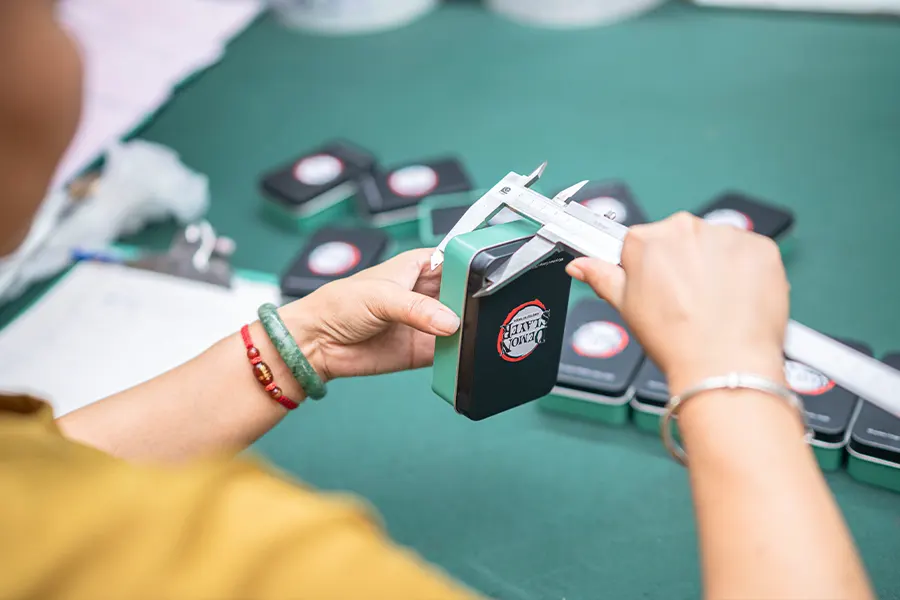
- Matériaux entrants: Les opérateurs utilisent des pieds à coulisse et des spectromètres sur le fer blanc brut et les fermetures pour vérifier les qualités exactes d'alliage et l'épaisseur de la tôle..
- Configuration du premier article: Les équipes qualité effectuent des inspections initiales avec des micromètres et des jauges de hauteur pour confirmer l'alignement correct de la machine et de la matrice avant de commencer les séries complètes..
- Intégrité des coutures et des fermetures: Les testeurs de fuite à pression et à vide vérifient les doubles coutures et les couvercles pour éviter des défaillances critiques telles que la perte d'étanchéité à l'air..
- Vérification du revêtement: Des jauges d'épaisseur spécialisées et des tests d'adhérence en coupe transversale garantissent que les vernis protecteurs adhèrent correctement pour éviter une corrosion précoce ou un écaillage..
Utilisation du contrôle statistique et de l'analyse des causes profondes
Les outils physiques détectent les défauts immédiats, mais les méthodes statistiques suivent la santé des processus à long terme. Les directeurs d'usine ont besoin de données pour détecter les dérives avant qu'elles ne se transforment en ferraille.
- Contrôle statistique des processus (CPS): Les cartes de contrôle suivent la stabilité des dimensions et la qualité des coutures au fil des équipes, détection de l'usure subtile de l'outil ou de la dérive thermique.
- Priorisation des défauts: Les feuilles de contrôle enregistrent le nombre de défauts, tandis que les graphiques de Pareto les classent pour montrer quels problèmes de fabrication nécessitent des ressources immédiates..
- Analyse des causes profondes: Lorsque des échecs récurrents de revêtement ou d’impression se produisent, les équipes appliquent des diagrammes de cause à effet et les 5 Méthode Whys pour trouver et corriger la source sous-jacente.
- Libération du lot final: Les inspecteurs utilisent une limite de qualité acceptable (NQA) protocoles d'échantillonnage pour maintenir une cohérence stricte lors de la version finale sans le goulot d'étranglement d'une inspection manuelle complète.
Comment améliorer la cohérence grâce au contrôle qualité
Un contrôle qualité cohérent élimine les conjectures subjectives en appliquant des normes mesurables, normaliser les flux de processus, et suivre les mesures en temps réel pour prévenir les défauts avant qu'ils ne surviennent.
Standardisez les processus et cartographiez les points de contrôle critiques
La cohérence commence par la suppression de l'ambiguïté dans l'usine. Vous avez besoin d'une approche structurée pour transformer des attentes générales en attentes concrètes., points de données vérifiables à chaque étape de la production.
- Définir des normes: Traduire les exigences clients et réglementaires en spécifications mesurables pour définir des normes de qualité claires.
- Rédiger des SOP: Documenter les procédures opérationnelles standard détaillées (SOP) qui décrivent des instructions étape par étape, entrées, outils, et critères d'acceptation.
- Cartographier le flux: Cartographiez l'ensemble du flux de production ou de service pour visualiser les interfaces et identifier les étapes à haut risque d'où proviennent les défauts..
- Définir des points de contrôle: Identifier les éléments critiques pour la qualité (CTQ) caractéristiques et définir des points de contrôle spécifiques avec des méthodes de mesure et des fréquences d'échantillonnage définies.
- Éliminer la subjectivité: Développer des modèles de liste de contrôle principale avec des exemples visuels et exiger des preuves photographiques aux points de contrôle pour réduire les décisions subjectives.
Mettre en œuvre des systèmes de mesure et de surveillance robustes
Vous ne pouvez pas contrôler ce que vous ne mesurez pas. Une opération de fabrication fiable repose sur la collecte de données en temps réel et un audit continu pour détecter rapidement les écarts de processus..
- Appliquer le CPS: Appliquer le contrôle statistique des processus (CPS) utiliser des cartes de contrôle pour suivre les variables critiques et repérer les tendances avant que des défauts ne surviennent.
- Centraliser les données: Centralisez la collecte de données de qualité dans un système numérique unifié pour surveiller les mesures en temps réel telles que les taux de défauts., rendement au premier passage, et retravailler les causes.
- Examiner les KPI: Organiser des examens de qualité périodiques pour analyser les indicateurs de performance clés (KPI) et comparer les performances entre les équipes et les sites.
- Processus d'audit: Planifiez des audits internes et des réinspections aléatoires pour vérifier le respect des SOP, valider l'étalonnage de l'équipement, et détecter les préjugés des inspecteurs.
- Corriger les causes profondes: Suivez systématiquement les tendances des erreurs à l’aide de l’analyse des causes profondes, et mettez à jour les flux de travail standard une fois que vous avez validé les améliorations des processus.
Comment choisir un fabricant de boîtes en fer blanc axé sur la qualité
Arrêtez de choisir des fournisseurs uniquement en fonction du prix. Un fabricant axé sur la qualité contrôle ses propres lignes de production, maintient des dossiers de conformité stricts, et prouve la cohérence grâce à des tests documentés à chaque étape.
Capacités et informations d'identification de l'usine
Vous avez besoin d'un fournisseur qui fabrique réellement le produit, ce n'est pas un intermédiaire qui passe des messages. L'évaluation des capacités de base d'une usine distingue les vrais fabricants des sociétés commerciales et garantit qu'ils peuvent répondre à vos demandes opérationnelles spécifiques..
- Propriété de la ligne de production: Vérifiez qu'ils sont directement propriétaires du formage, impression, assemblée, et installations de contrôle qualité interne.
- Certifications de conformité: Examinez les licences commerciales et faites correspondre les certifications comme ISO 9001, FDA, ou BRC/IOP selon les réglementations spécifiques de votre marché final.
- Alignement des capacités: Faites correspondre leur quantité minimum de commande (Quantité minimale de commande) et l'évolutivité de la production en fonction de votre stratégie de lancement et des délais de livraison standard attendus.
- Expérience à l'exportation: Confirmez que le fournisseur dispose d'un historique d'exportation direct pour rationaliser la documentation douanière, logistique, et performances d'emballage des palettes.
Systèmes de contrôle de qualité et tests de production
Un fabricant fiable n’attend pas que les cartons soient emballés pour vérifier les défauts. Ils mettent en œuvre un contrôle de qualité strict depuis le moment où les matières premières entrent dans l'installation jusqu'au sceau final..
- Dossiers d'inspection: Exiger des enregistrements documentés couvrant les matières premières entrantes, contrôles de formage en cours, et évaluation des produits finis.
- Spécifications des matières premières: Vérifiez que l'épaisseur du fer blanc se situe entre 0.23 et 0.30 mm pour garantir la durabilité structurelle sous charge.
- Échantillons de pré-production: Approuver les échantillons physiques pour tester la précision des dimensions, fermeture du couvercle, cohérence des couleurs d'impression, et l'intégrité des coutures avant le début de la production de masse.
- Documentation de sécurité: Demandez des documents spécifiques de conformité au contact alimentaire et les résultats des tests de migration si vous envisagez d'emballer des aliments ou des suppléments..
Foire aux questions
Pourquoi le contrôle qualité est-il essentiel pour la fabrication de l'étain?
Le contrôle qualité garantit la sécurité alimentaire, conformité réglementaire, et l'intégrité du produit. Il empêche la migration chimique, contamination microbiologique, et les dangers physiques comme les bavures pointues. De solides pratiques de contrôle qualité protègent également la réputation de la marque et réduisent les coûts unitaires en minimisant les rebuts et les reprises..
Quelles sont les principales normes de test pour les boîtes en fer blanc?
Les tests normalisent l’intégrité des matériaux, performances de fermeture, sécurité au contact des aliments, et qualité d'impression. Les exigences typiques maintiennent la variance de la jauge du fer blanc à ± 0,01 mm, ciblez la force de retrait du couvercle à ajustement par friction entre 10 et 20 N, et limiter la migration chimique globale à 10 mg/dm² sous UE 10/2011. Les équipes de production maintiennent également la précision des couleurs d'impression à ΔE ≤ 1.5 par rapport à la preuve approuvée.
Comment les usines préviennent-elles les défauts courants de l’étain?
Les usines préviennent les défauts en gérant la qualité des matériaux, paramètres de processus, et les conditions environnementales. Dans l'emballage, les équipes veillent à la propreté de la surface du fer blanc et appliquent des revêtements de protection précis pour arrêter la corrosion. Pour les composants électroniques, les fabricants sélectionnent des finitions en étain mat et contrôlent la chimie du bain de placage pour réduire la croissance des moustaches d'étain. L'inspection optique automatisée détecte les rayures de surface, étain manquant, ou des coutures défectueuses au début.
Quelles mesures spécifiques les inspecteurs prennent-ils lors de la vérification des boîtes métalliques?
Les inspecteurs évaluent les matériaux à leur arrivée, surveiller le formage et le soudage sur la ligne, et tester les boîtes finies. Ils vérifient le fer blanc brut pour vérifier l'épaisseur et la qualité de la surface.. Pendant le montage, ils vérifient l'intégrité des doubles coutures pour éviter les fuites. Les tests finaux incluent des contrôles de chute et de compression selon ASTM D4169 pour simuler les risques d'expédition, s'assurer que l'emballage protège le contenu pendant le transport.
Pensées finales
Même si les fournisseurs à bas prix peuvent proposer des prix initiaux inférieurs, un partenariat avec un fabricant qui applique un contrôle statistique strict des processus est le seul moyen de protéger votre marque. Ignorer ces points de contrôle d'inspection critiques vous rend vulnérable à des rappels de produits coûteux., défaillances structurelles, et des relations de vente au détail endommagées. La véritable rentabilité vient d’une cohérence, un emballage métallique sans défaut qui protège activement votre produit et vos marges.
Arrêtez de deviner la qualité de l'emballage et commencez à la vérifier avec des preuves tangibles. Nous vous recommandons de demander un échantillon de pré-production pour tester l'intégrité structurelle, ajustement du couvercle, et alignement d'impression de première main. Contactez notre équipe de production dès aujourd'hui pour verrouiller vos spécifications OEM et obtenir un partenaire de fabrication fiable..